
Piemonte in Inverno
Piemonte in Winter

Farming, foraging, fishing, and family strip me of expectation. I’m convinced it’s meant as preparation for the bigger game fish of geopolitics, let-them-eat-cake wealth, and the eternal promises of organized religion, all of which, in this exigent moment, make me want to horde a cache of barbs to pair with several bottles of mature Bordeaux. Even gold-plated toilets are ringed in shit.
Expectation is the kissing cousin of entitlement. Years ago, when I commented on how fortunate we are in life, my father corrected me, noting we were entitled to it. We weren’t lucky; he felt it was his due. The part unspoken was his due was owed (and taken) because he was a white male. There was no acknowledgement of luck, good fortune, right-place/right-time, and therefore, no expression of appreciation or empathy. I’m left scratching my head when one believes one is deserving of anything in life.
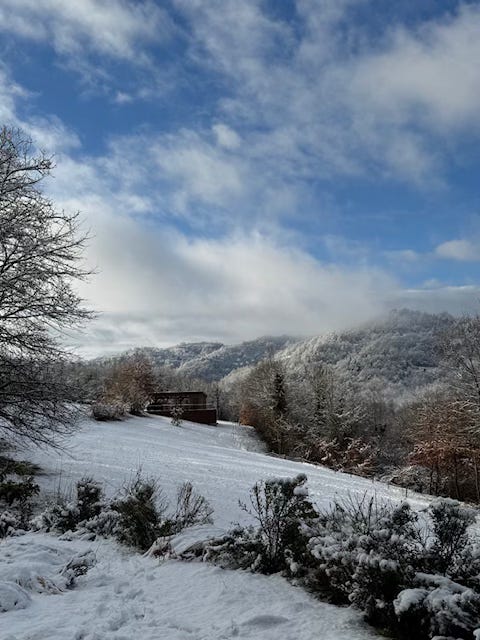
Living rurally, there’s plenty of time to walk, garden, cook, think. Looking into the rear-view mirror, too easily done if one lives quietly in the woods, there is a spaciousness of time to examine the psychosis of family. But there is opportunity, too, for the occasionally glimpse of a life carved from dreams: a garden that produces madly; smoke rising from the oven stoked with collected kindling; the wood, stone and glass structure we now occupy, which looks out onto snow covered hills, the long driveway lined with flowering plum trees and gates hung with corten peace signs; the bird and bee boxes, the bowl of kibble for the feral cats from up the hill.
Spending precious later-in-life chapters in other countries, my expectations were high for experiences, people, ease of life. In fact, nothing has been easy. Perhaps I suffer from the same entitled delusions as my father. I haul my baggage everywhere, weighty with expectation, and much like my enthusiastic grin, a very americana trait. The shield of gratitude wards off some of life’s hiccups but can quickly shift into attachment to the object of thanksgiving, picking up speed before landing in the industrial town of need. What I once believed I needed to live by has been debunked by a life spent elsewhere, among those with entirely different expectations.
Piemonte in winter is an acquired taste. Days are often gray and frigid, like the mother you never deserved. Fields are either frozen solid or piled with a light-brown mud that clings to the dogs’ paws, their prints hennaed onto wood floors. Threats of snowstorms blown in from higher mountains force this prepper to (re)evaluate the adequacy of our stored provisions. But like a winter plein air, the vistas of snow on the Alps steal one’s breath, and even the lower hillsides surrounding our canyon remain white, the evening temps making melt impossible. Curlicues of smoke rise from the brick chimneys of ancient farmhouses, which, except for the skittish movements of feral cats, appear largely abandoned.
Trees stripped of their leaves allow for the clear echo of church bells, even when tramping the deepest forest. Birds’ nests are visible, their occupants’ urgency to find food guilting me into frequently filling the feeders. Electric fences keep ginormous boar at bay, but do nothing to discourage the nimble deer, whose hooves easily clear the zapping wires, and all but the smallest does exhibit no fear from the yap of the dog. Foxes mostly show themselves at night to gorge on voles, but a glimpse of the large, furry red coat, sitting lazily on the snow in mid-afternoon, its face distinct and stunning, makes me wish I’d studied wildlife photography under Paul Nicklen.
During the first few winter seasons spent in Piemonte, Sunday mornings left us jittery from loud shotgun blasts, the designated day for the state-sanctioned slaughter of wild animals. Please don’t misunderstand me: I’m not judgmental about the activity, having once been an enthusiastic hunter, even a decent shot. Rather, my attitude stems from the proximity to our property where it occurs. In California, hunting was done either on private land or on reserves, both far removed from suburbia. After expressing disapproval to the encroaching hunters in a tongue that made it clear we’re outsiders, we were reminded that if it ain’t fenced, the law says dogs and their masters are free to roam, especially if on the trail of an animal. But after witnessing the distress of the two American women who’d taken over the land they once freely traipsed, they’ve realized hunting near our house is a non-starter, even expressing gratitude at the hectares of land left wild. Now, in a turn-of-the-tables acclimation, we message Matteo, the lead hunter, when we see boar close enough to be able to count their tufts of hair. This hunter hotline has paid us in chops and shoulders, which require a long marination and a slow roast for deliciousness.
Keeping populations sotto controlo mean no boar in the garden, while providing the old men a reason to gather. In the din of late afternoon, the famous Piemonte fog settling over the valley, they can be spotted in a nearby barn, the blaze-orange jackets tossed onto the backseats of the gathered 4x4 Pandas. The men smoke, drink wine, and gossip while carving up the heavy carcasses hanging from the rafters before splitting the afternoon’s spoils amongst themselves.
I asked one of the local hunters, with whom I’ve made an abiding peace, if he bagged bird. He scoffed with visible derision. “Only girls hunt birds.” Perhaps with remorse for his chauvinism, or merely trying to be a good neighbor, he brought me half a dozen wild birds, no doubt shot by a female hunting buddy. Flipping through the half-frozen carcasses, I became nostalgic for my time spent in the fields.
Rising before dawn in Northern California, I would often go hunting by myself, loading into my little trunk a shotgun and a beat-up leather doctor’s bag packed with ammo, earplugs, cheese and crackers, a blaze-orange scarf and vest. Putting the top down and the heater on, I drove the hour north to the fields, watching the sun rise an ashy rose. I recalled reading a book of essays on hunting gifted to me by one of my mentors. This gentleman was an outstanding shot who was very quick on the draw, but during our last outings together, he bogarted all the birds. It was then that I decided I prefer hunting alone. I didn’t want to take turns shooting, to listen to more advice, or to have the quiet solitude of Nature’s morning interrupted. Bonding with comrades in arms is always a delicate balance in the great outdoors; to say just enough but not to prattle on, spoiling the grandeur of the day.
Early on, I hired a trainer for shooting lessons before bad habits became ingrained. Learning to shoot was like learning to drive a clutch. Initially, I stalled out as many times as birds got lucky, but then something just clicked, and I owned it. My guide on that long-ago day was an older man, tall and heavy set with jowly cheeks, who smoked a good cigar as we walked. He talked about his hunting trips, training his dogs, and his good fortune in having retired from a desk job to hunt full-time. While the young guys at the hunting clubs eyed me warily, the older men were quite solicitous. The old guard feels under constant threat to give up their arms, their way of life, their hunts. Several men explained to me that it’s women and children, by their enthusiastic participation, who will save the art of hunting; new blood to preserve the ritual of its spilling.
On one of the first January mornings in Northern California that wasn’t pouring a cold, unremitting rain, the sky was cloudless, and a spongy mud, semi-frozen in areas, clung to my old hunting boots. As I didn’t have a hunting dog, I traded a couple of good bottles of Barolo for the company of a German short-hair, the dog of a friend’s friend. The two of us hiked for miles. Nearby pastures held grazing sheep serenading us with an occasional bleat, the upcoming light reflected off the hills, and autumn’s agricultural patchwork was still present. We hiked through brambly brush, my legs covered in thorny burrs that left deep scratches for days. The dog, a kindly old girl oddly named Poacher, suddenly stuck her freckled snout into the air and began to dance as if to an unheard tune. Back and forth, she swept the field in front of us, hot on the scent of a bird on this chilly morning, an incredible sight attributable to equal parts genetics, breeding, and training. The dog finally surprised a fat pheasant tucked behind a clump of grasses, flushing him quickly into the air. Considering their size, pheasants are fast; their spindly legs often sprint them into the next field before I’m able to even sight them with the tip of my shotgun. That long-ago morning, I bagged two beautiful male pheasants as the sun came up. Poacher retrieved them, but it took a bit of work, cunning, and more than a few biscuits to coax her into dropping the birds so I could tuck them into my game bag. Laughing out loud, I cursed her Master, now groking the origin of her name.
The ringed-neck pheasant is a wonder of color, its plumage deep, rich hues only Nature can produce. The bird was first imported from Asia in the early 1700s. George Washington had pheasants roaming Mount Vernon, and Ben Franklin’s son-in-law brought them to his home in New Jersey. Their population exploded in the late 1800s when a hunting enthusiast, a consul to China, released several dozen Chinese ringnecks into Oregon’s Willamette Valley. They multiplied with ferocity until the 1960s, when ag lands were stripped and given over to monoculture and development. Thanks to conservation efforts, however, no other game species introduced to the United States has thrived as well as the pheasant.
Wild pheasants are not native to Italy, nor even to Europe. Here, too, they were introduced to the continent from Asia. It’s speculated that the birds with the fancy plumage were brought here by the food-loving Romans during their empire phase. Pheasants have since become naturalized, with large populations of wild flocks living in the Italian countryside.
In Italy, foreigners are permitted to hunt but must have specific documentation, such as a valid U.S. hunting license, a gun permit, or a federally approved guide. Hunting here is considered a public service (animal control), and it’s tightly regulated. When I inquired of our notary about getting a gun, he looked at me incredulously. “Only crazy people or criminals have guns in Italy.” As I struggle with the requirements to get an Italian driving license or pass the A2 Language Test, I’m confident that I’ll never look down the barrel of my own shotgun here, which, given the lack of proliferation of firearms in Italy, is a relief to me.
The hunting season for most animals runs from September through February, with the peace of the hills punctuated by shotgun blasts and howling dogs on Sundays and Wednesdays, and while most hunters in this area track boar, pheasant is one of the most hunted wild species up and down the boot. The gold standard for hunting birds is the flat area of the Vercelli area, situated in the northern corner of Piemonte on the Sesia River, and an area of great importance for Europe’s rice production. Arborio, anyone? Field after field of low corn stubble is separated by wide ditches nursing pools of brackish water, creating perfect hideouts for pheasant, partridge, snipe, and ducks, with plenty of corncob remnants on which for them to feast and fatten. Pre-dawn air, heavy with dew, provides ideal conditions for hunting game birds, as their scent lingers on the wet grasses, making the dogs crazed. Come summer, however, the only things hovering above the water in that area are ferocious mosquitoes. Sitting outside one evening, watching a thunderstorm over the rice fields, I was encircled by swarms of black clouds, like tiny drones out for blood.
The 40 species of pheasant, all originating in Asia and Asia Minor, are related to partridge, quail, grouse, and guineafowl, all of which encompass the order Galliformes (heavy-bodied, ground-feeding birds), and all of which are, not incidentally, delicious. But in that pile of birds gifted to me by a Piemonte neighbor, it was the pheasant for which I was most excited. After years of hunting birds in California and Montana, I was expecting a similar gustatory experience. Is the need for comparison baked into the human experience? Or can we learn to just accept what is, in the moment it’s offered?
Much of the herb garden remains alive, green heads crowning through the snow’s crust. Branches of sage and thyme and the indestructible rosemary are snipped and stuffed into the bird’s cavity, which is no larger than my fist. Snug on a bed of onions and carrots shopped from our cold storage and Piemonte’s famed red and yellow potatoes, scored from a neighbor, the plucked pheasant is slathered in butter, sea salt, and a wild black pepper discovered in an Antibes spice shop, truly sauvage.
After the skin pulled away from the feet, the carrots shriveled, and the potatoes crisped to a hue of brown identical to the Piedmontese earth, the whole kit-n-kaboodle rested, cooling the bird but not my excitement. Armed only with a fork, we stood at the counter and pulled the breast meat away from the ribs, only a few, precious bites for each. The onions melted into a gamy jam, the carrots were made sweeter by winter’s bleakness, and the potatoes were salted and dragged through the juices like the best mopping-up bread. Measured against a former life, often made more delicious in recollection, the Italian experience was leaner, a hair gamier, but no less sating.
As any game bird lover will note, it is not the meat but the broth that nourishes. Every scrap was scraped into a stock pot, covered with mirepoix, lemon rinds, black and red peppers, and old pieces of ginger, turmeric, and Parmigiano rescued from the freezer, along with a big glug of Amontillado sherry. Pheasant stock makes me weak-kneed.
The Chinese recognized the beauty and delicacy of the pheasant more than 3,000 years ago, believing they represented prosperity and good fortune. The Romans, true gourmands all, introduced the pheasant into Western Europe. Julius Caesar brought the bird along when he invaded England in the first century B.C., also believing the pheasant auspicious.
A bowl of grated Pecorino, with a whisper of shredded thumb skin, sat on the coffee table in front of the fireplace. Thick linen napkins permanently stained with the colors of hundreds of meals are laid next to heavy, old French soup spoons scored from a flea market, which demand to be washed only by hand. Bitter rapini wilted with garlic and dried hot chilies from the summer garden were added to the soup bowls. While debating the likelihood of the next snowstorm, we ladled the steaming broth over the greens and floated heart-shaped ravioli filled with radicchio from a mom-and-pop shop in Finale Ligure that brings tears to my eyes. An old Chateauneuf-du-Pape was uncorked, and for once, anticipation outweighed expectation.
Makes me nostalgic for my years publishing and editing Edible Marin & Wine Country, with your incredible stories gracing many of its pages. And nothing else has evoked that nostalgia-in 2+ years! Thank you!!! Sending lots of love to you Lisas!
I can’t wait to subscribe Lisa!! Such a fave fave writer you are!! 🤎🩶 signed, Chipmunk Hater! 🐿️